Prior knowledge
2D Geometry
The first type of geometry you learned is 2D geometry (circles, squares, rectangles...) - the stage for all of these is the Cartesian coordinate system, or, simply, the xOy system. The applet below shows some of the shapes you know from 2D space and their relevant defining properties. You may change the properties of the shapes by dragging the sides.
Simple shapes
Points
All shapes are made using points - we may construct a plot of the points using ordered pairs of numbers called coordinates - typically taking on the form . Use the following applet to review how are these kinds of points plotted and how we read of the coodinates of points.
Midpoints
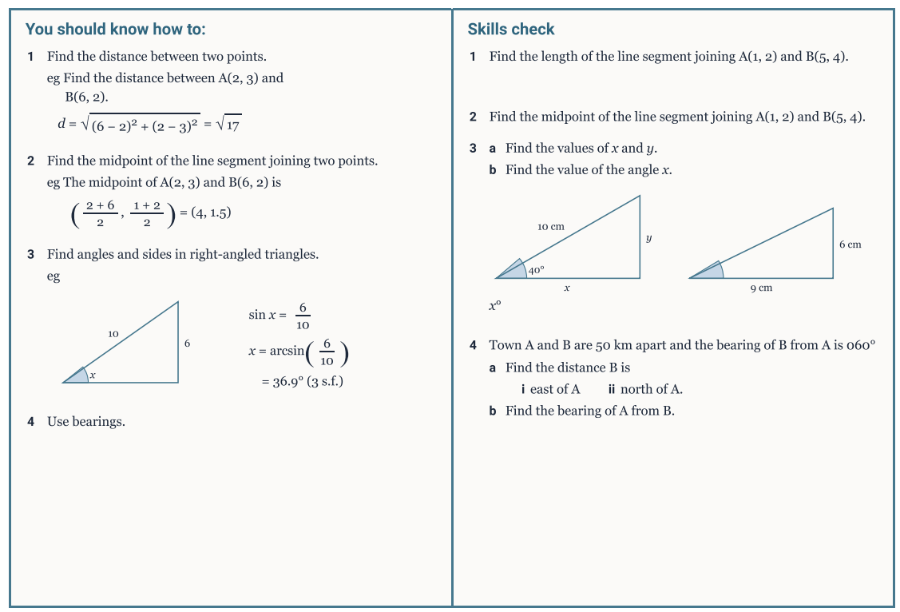
The midpoint is a point which splits a line segment into halves of equal length. To find it, we may simply find the "middle" number of the respective x and y coordinates of given points.
Plotting points
Distance of points
The distance of two points can be calculated using the pythagorean theorem. The followin applet shows how to, in general, understand the formula for the distance of two points.
Basic trigonometry
We can use the ratios between sides of right-angled triangles to workout the angles opposite or adjacent to a specific leg of said traingle. The three basic ratios are called sine, cosine and tangent. The following applet shows the relationship between the angle and the ratio of legs to the hyppotenuse.
Right-angle triangle trigonometry
Bearings
To describe a specific direction in the coordinate plane (or on a map), we use bearings. Those are defined as angles, measured from the North (positive y-axis) to the desired point, clockwise. The following applet shows a bearing of point C. Points A and C can be freely moved.