Forced damped harmonic ocillator
forced-damped harmonic oscillator model (RWTH Hausaufgabe)
[DE]
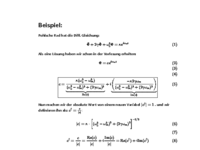
Hier teilen wir unseren Versuch, Lernmaterial zu erstellen, um mit dem Modell des erzwungenen-gedämpften-harmonischen Oszillators zu spielen. Dazu verwenden wir den solveODE-Befehl in GG, und beim Lösen der Differentialgleichung haben wir ein paar Parameter als Sliders gewählt, um ein tieferes Verständnis des Modells zu erhalten. Beachten Sie jedoch, dass wir uns für folgende Anfangsbedingungen entschieden haben:
Max. Amplitude (Auslenkung): 1
Anfangsgeschwindigkeit: 0
Sonderfälle:
1.alle Variablen sind Null: das Objekt bleibt in Ruhe.
2. ist positiv: beschleunigte Bewegung gegen das positive Unendliche, mit Anfangsgeschwindigkeit Null.
3. ist positiv: freie harmonische Bewegung mit Anfangsgeschwindigkeit Null und Startposition: 1.
4. st positiv: freie harmonische Bewegung mit Anfangsgeschwindigkeit Null und Federkonstante .
5. sind positiv: freie gedämpfte harmonische Bewegung.
6. sind positiv: feie gedämpfte harmonische Bewegung mit konstantem Kraft.
7. Aperiodischer Grfenzfall der gedämpften harmonischen Bewegung.
8. sind positiv: Erzwungene gedämpfte harmonische Schwingung mit Resonanzfrequenz
Resonanz tritt auf, wenn die Frequenz des Krafts die „Resonanzfrequenz“ erreicht und die Amplitude der Schwingungen ihr Maximum erreicht. Man kann die Werte in den Slidern ändern und prüfen, wie die Resonanz eine drastische Veränderung ist, wenn die beiden Frequenzen zusammenfallen.
[EN]
Here, we share our attempt at creating learning material for playing with the forced-damped harmonic oscillator model. To do that, we use the solveODE command in GG, and with solving the differential Eq. we chose parameters as sliders to obtain a deeper understanding of the model. notice however that we decided on the following initial conditions:
Max. amplitude (displacement): 1
Starting velocity : 0
Special cases:
1. all variables are zero: the object remains at rest.
2. is Positive: accelerated motion towards positive infinity, with zero initial velocity.
3. are positive: simple harmonic motion with initial velocity zero and starting position equal to 1.
4. is positive: simple harmonic motion with initial velocity zero and spring constant .
5. are positive: simple damped harmonic motion.
6. are positive: simple damped harmonic motion with constant force applied to it.
7. Aperiodic state of damped harmonic motion.
8. are positive: Forced damped harmonic oscillation with resonance frequency
Resonance occurs when the frequency of the applied force reaches "Resonance frequency" and the amplitude of the oscillations reaches its maximum, one can change the values in the sliders and check how the resonance is a drastic change when the two frequencies coincide.