EDSC 121 - Triangle Inequality Theorems (Lesson Proper)
EDSC 121 - Relationship of Angles and Sides of a Triangle
The Relationship of Sides and Angles
Fundamental trigonometric and geometric rules govern the relationship between the sides and the angles of a triangle:
A. Direct Size Relationship
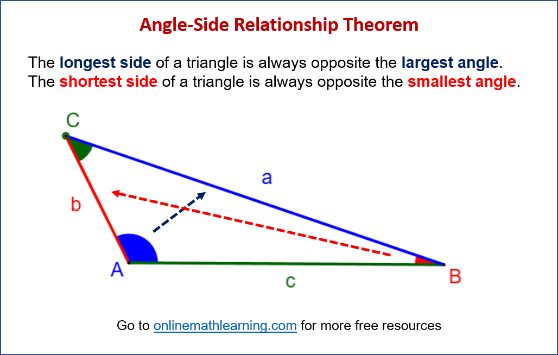
This stipulates that the measurements of angles and sides are directly proportional to one another. The larger the side, the larger the angle, and the smaller the angle, the smaller the side, and vice versa.
B. Triangle Inequality
Theorem 3, in our lesson, specifically deals with this. According to its definition, the sum of the lengths of any two sides of a triangle must always be greater than the length of the third side.
C. Angle Sum Property
The sum of all three interior angles in a Euclidean triangle is always 180 degrees.
References:
Kirk, D. (2023). Triangles. Contemporary mathematics. OpenStax. https://openstax.org/books/contemporary-mathematics/pages/10-3-triangles
Yoshiwara, K. (n.d.). Side and angle relationships. Trigonometry. https://yoshiwarabooks.org/trig/Side-and-Angle-Relationships.html
EDSC 121 - Exterior Angles
Exterior Angle Inequality Theorem
The measure of an exterior angle of a triangle is greater than the measure of either remote interior angle.
Key Concepts:
Exterior Angle – an angle that forms a linear pair with one of the interior angles of a triangle.
Remote Interior Angle – an angle of a triangle that is not adjacent to a specified exterior angle.
Linear Pair Theorem – if two angles form a linear pair, then the two angles are supplementary and adjacent.
Lesson Guide
In our applet, the exterior angle is angle CAD, and its adjacent angle is angle CAB. The sum of their measures equals 180 degrees, or they form a linear pair.
Even if we manipulate the applet, the measure of angle CAD will always be greater than the measures of angles BCA and ABC.